Nature, Illuminated
Our scientists shed light on stunning bioluminescent creatures

By Jessica Portner and James Yang
"The microscopic Noctiluca scintillans, whose name means night light, uses its tentacles to gather food. Tiny shrimps the size of sesame seeds, called "fireflies of the sea," emit light to attract mates. Megamouth sharks "wear" shimmering plankton-like lipstick to lure prey.
Bioluminescence, the production of light by an organism, is a spectacular evolutionary adaptation in the animal kingdom. Our experts shed light on the often-unseen incandescent cohabitants of our planet.
Jody Martin, NHM’s Associate Vice President of Research and the Curator of Crustacea, researches morphology (form, function, and adaptation), natural history, and evolutionary relationships of crabs, lobsters, shrimps, and their many relatives in habitats all over the world. When asked about the standout light-makers in the museum collection, Martin thinks of little seed-shaped crustaceans that emit light as part of their mating dances.
“The seed shrimp are really, really cool because they use this function as an attractor just like fireflies. They have distinct patterns you can recognize, like Morse Code. For example, “it's a ‘boom, boom, boom, boom’ and or a ‘pop’ and you can tell the difference.” They use this function to avoid being prey.
“Fish are the main predators. But other crustaceans too and squid. Shrimp are in everybody's lunchbox,” says Martin. “It's a good tool if you're on the menu to be able to scurry away in different ways and communicate.”
Radiant Worms
Many other marine dwellers are known for their sparkle and shine—polychaetes.
Leslie H. Harris NHM's Senior Collections Manager in Polychaetes says the vast majority of bioluminescent polychaetes produce blue or green light, but a few like the gossamer worms are capable of emitting yellow and yellowish-orange fluids or lighting up their appendages from inside their bodies.
Like their ocean neighbors, polychaetes often bioluminesce for two specific reasons: first, their colorful lights can attract worms of the opposite gender in their mating patterns, similar to how peacocks show off their feathers. Female glowing fireworms, for example, swim in circles near the surface of the water and leave glowing bluish-green mucus trails, clumps made of their gametes (egg cells) in their wake in order to attract male fireworms, which come dashing in like comets at the sight to release their own sperm into the water. These polychaetes’ sperm and egg cells fertilize externally in the water instead of inside their own bodies like humans.
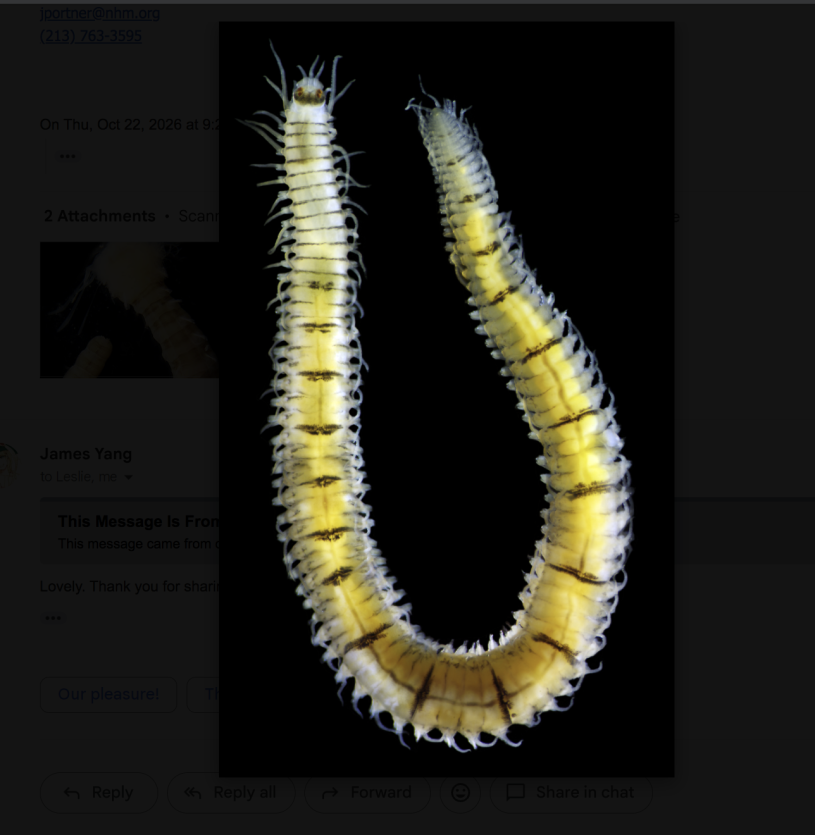
Polychaetes often swim to the surface of the water when the moon is full, where the seafloor is shallow so that their gametes can be fertilized easier. The second primary biological reason for bioluminescence is to escape or distract predators. For example, green bomber worms have gills that can generate up to eight bombs of glowing light at a time. It’s a diversionary tactic—they explode into a brilliant burst of bluish-green light, while the green bomber worm swims away.
“You can go to a dock in Southern California on a full moon night. Some people like to bring underwater lights or waterproof lights that they put down into the water, and that'll bring up a lot of critters. They’re just under the mud—worms are everywhere,” said Harris. “What I find really interesting is that even though there are a lot of polychaetes that have blue bioluminescence, they live inside tubes that are buried in the ground or between rocks. It’s not as if they’re shining out in the open—they're doing it inside the tube. And nobody knows why.”
Flipping the Switch
Glow isn’t the province of biological beings only. Some natural rocks and crystals display different colors when exposed to invisible ultraviolet (UV) light. “When high-energy light, like ultraviolet light, strikes the mineral, electrons absorb that energy and jump to a higher energy state. Afterward, the electron eventually falls back to its normal energy state, but to do that, it has to release a little energy as light,” explains Aaron Celestian, NHM’s Curator of Mineral Sciences.
“That light being emitted when the electron cascades back down is what we see as fluorescence.”
Depending on the type of UV light, UVA, UVB, or UVC—which are different energies of ultra-violet light—you can get colors. In the case of ruby, it’s the chromium. In the case of kunzite, it’s manganese. If there is a little of manganese, then the manganese electrons are easily excited and will cause pink or red fluorescence.

Under UV light, willemite (green) and calcite (red) pop with vibrant colors

Benitoite under UV light

